Table of Contents

Acknowledgement of Country
Tomorrow Architect acknowledge that our offices are on the traditional lands of the Wurundjeri People of the Kulin Nations. We pay respect to elders past, present and future, and all First Nations people.
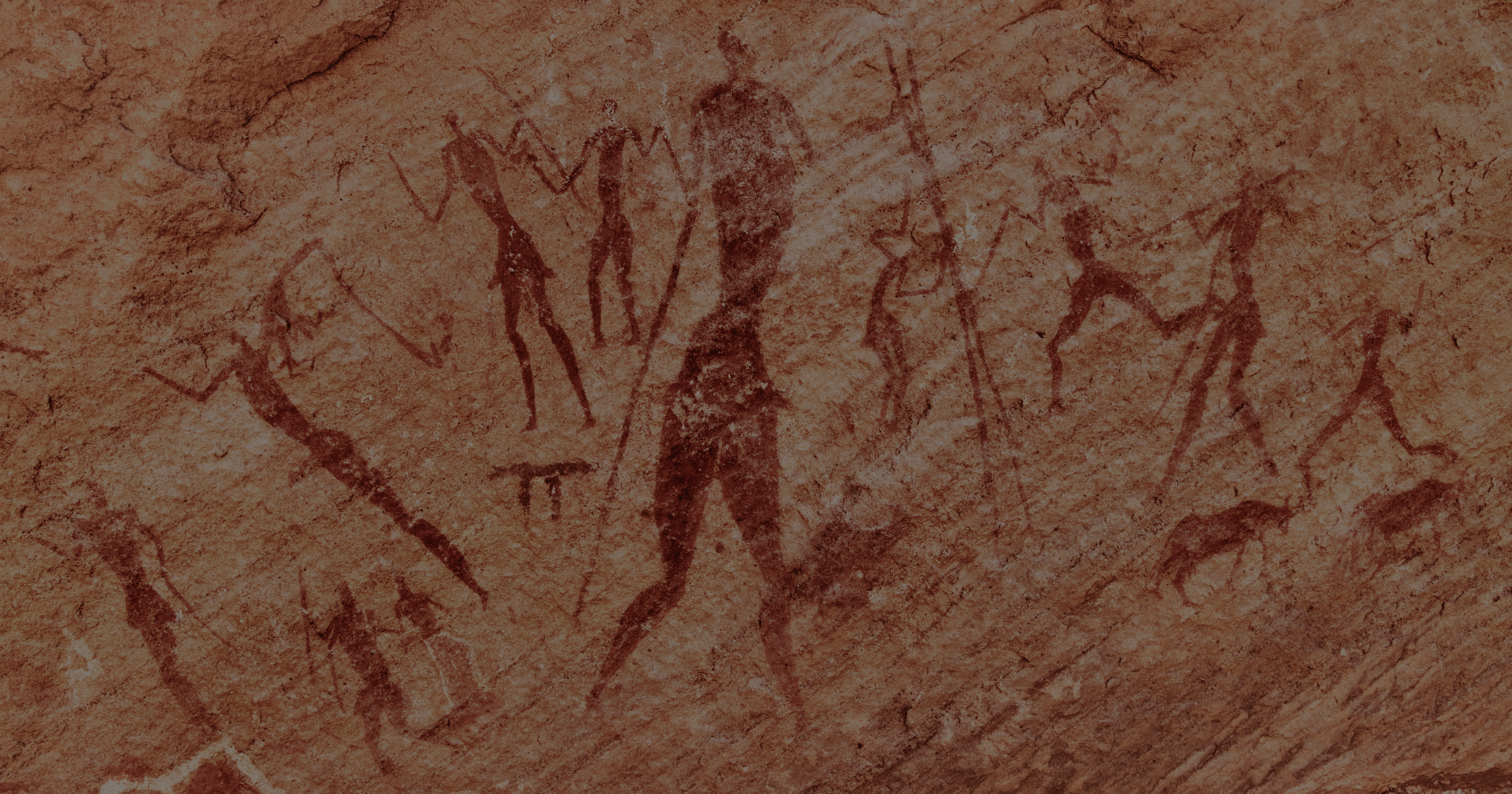
The brain you are leading with today is, in every structural sense, the same brain a hunter-gatherer carried across the plains 200,000 years ago, and human brain size has stayed remarkably stable for at least that long, according to the fossil record cited in Van Vugt and Ronay's review of evolutionary leadership theory. What has changed is not the wiring; it is everything the wiring now has to deal with.
For most of that time, humans lived in small, nomadic groups of around 150 people. By comparison, agriculture, cities, corporations and organisational structures are relatively recent developments, emerging roughly 13,000 years ago, according to Van Vugt and Ronay. We are running twenty-first century organisations on a psychological toolkit that was built for something else entirely. Try as we might, we can’t deny our evolutionary biology.
That explains a why a leadership team can pass every capability assessment and still not trust each other in the room. Why the person with the right title on the organisation chart isn't always the person the room actually follows. Why the skills that actually hold a group together under pressure were never really taught, only assumed.
"What has changed is not the wiring. It is everything the wiring now has to deal with.”
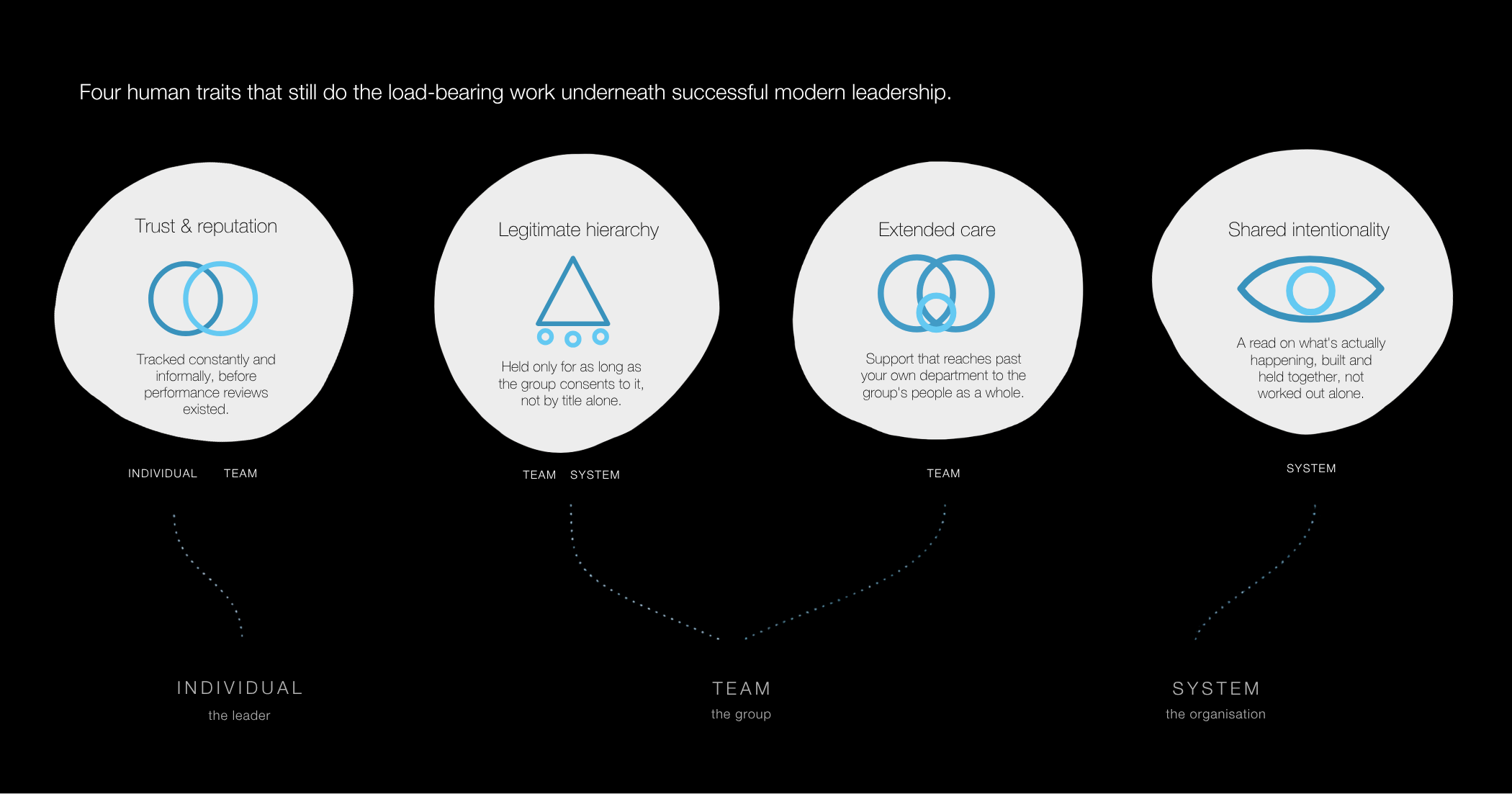
Small-scale societies did not survive on organisation charts or competency frameworks. They survived on trust and reputation, tracked constantly and informally, as Dunbar's work on gossip in evolutionary perspective shows. They survived on hierarchy that held only as long as the group consented to it, which is Boehm's argument in his work on egalitarian behaviour and reverse dominance hierarchy. They survived on care that extended past your own children to the group's children, the case Hrdy makes for cooperative child-rearing. And they survived on a shared read of what was actually happening, built and held as a group rather than worked out alone, which is what O'Madagain and Tomasello mean by shared intentionality.
Each of those deserves its own post, and there will be one for each of them in time. For now, the point is - none of this is an add-on to leadership, it is the load-bearing structure underneath it, and it maps closely onto how we think about capability at the level of the individual leader, the team and the system, the three stages behind our own work.
Ask most organisations how they select leaders and you will hear about competency frameworks, structured interviews, 360 assessments. Ask a hunter-gatherer band the same question, historically, and the answer was more direct - leaders emerged because the people they would lead decided to follow them, based on visible contribution to the group. Van Vugt and Ronay point out that modern leadership selection mostly runs the other way, candidates assessed and appointed by people above them in the hierarchy, with little input from the people who will actually be led. Is that evolution past the old instinct? It is not. It is the same instinct, in a different process.
We wrote about a version of the same pattern in wisdom versus knowledge - something old and genuinely load-bearing gets undervalued in favour of something newer and easier to measure. Competency frameworks are measurable. Legitimacy, in the sense a group actually grants it, is not, so it tends to get assumed rather than built.
There is a case for saying none of this matters much anymore, since machines can now process information, apply a rule and run a calculation faster than any person could. We do not think that case holds. If anything, it sharpens the question of what a human leader is actually for.
Van Vugt and Ronay note that in a more networked, less hierarchical world, interpersonal skill and social intelligence matter more than they used to, not less. Reading a room. Holding a group's trust. Sensing when a hierarchy has lost its legitimacy. A machine cannot do any of that well.
AI does not make ancient human traits irrelevant. It shines a light on the key differentiators of what it means to be innately human.
The instinct under pressure is to answer complexity with more complexity, more frameworks, more dashboards, more process. It is worth asking whether the more useful approach, at least some of the time, is the opposite one, building the emotional intelligence and interpersonal skill these traits actually require, on purpose, rather than assuming senior people already have them because they are senior.
None of this is nostalgia for hunter-gatherer life. It is a reminder that the traits which kept groups alive for two hundred thousand years did not stop being useful the day someone invented the quarterly performance review. We just built enough language on top of them to forget they were still doing the work, underneath everything else we measure.
If this is the kind of thing you think about, Leading Tomorrow, our monthly note on leadership development, from the rooms through to the research, is where we write about it in more depth.
Our perspective on leadership development, from the rooms through to the research. Monthly insight, from our team.
We’ll never spam you and unsubscribe whenever you like.

Quick Links
Acknowledgement of Country
We respectfully acknowledge the first custodians of the land on which we live and work, the Wurrundjeri People of the Kulin Nation. We pay respects to Elders past, present and emerging and to all First Nations People. Sovereignty was never ceded and treaties were never signed.
© Tomorrow Architects Year. Privacy Policy.