Table of Contents

Acknowledgement of Country
Tomorrow Architect acknowledge that our offices are on the traditional lands of the Wurundjeri People of the Kulin Nations. We pay respect to elders past, present and future, and all First Nations people.
We were running a group coaching session recently as part of an executive leadership program. One of the participants was sharing a challenge - something real and complex, the kind of thing that doesn't have a clear answer.
Within moments, another participant jumped in with advice. Good advice, well-intentioned, probably technically correct.
But it wasn't what was needed.
What the person sharing needed was someone to listen. Not to fix or reframe, but to sit with them and hear it through before moving to a response.
The first participant had knowledge. What the moment required was wisdom - the self-awareness to recognise that your knowledge isn't always the right tool.
It's a word that feels more common in philosophy than at work. Which might be why it's underused.
Wisdom isn't the absence of knowledge. It's knowing what to do with knowledge, when to apply it and when to hold it back, when the situation calls for something else.
Three independent research traditions have converged on this over the past four decades.
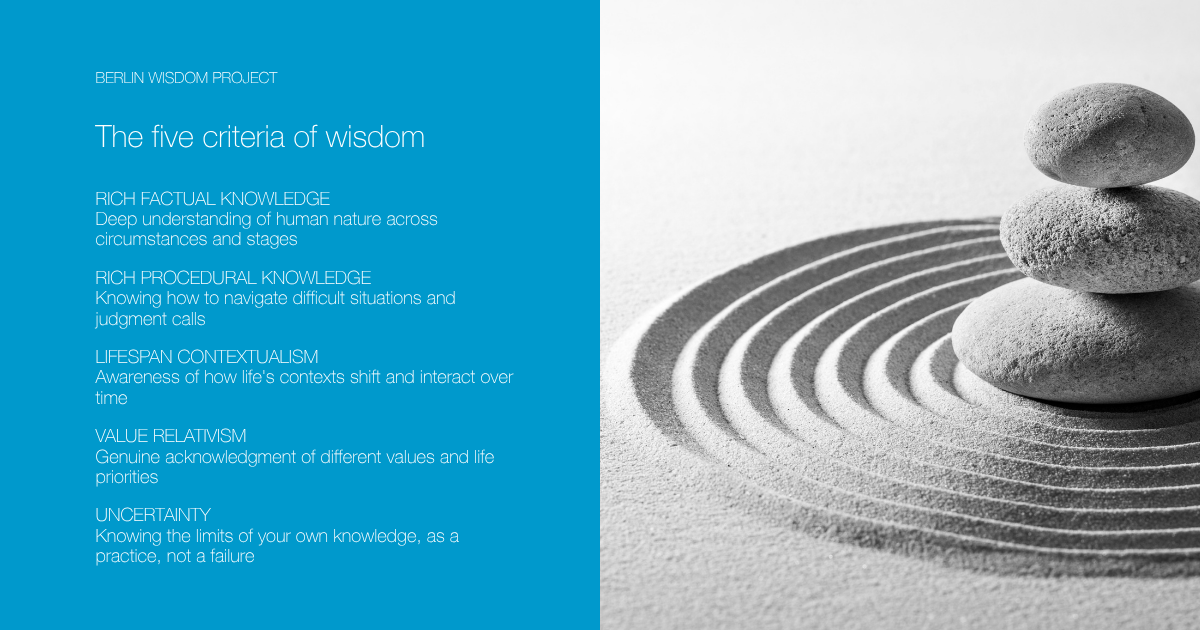
Paul Baltes and his team at the Max Planck Institute for Human Development spent decades studying wisdom empirically under the Berlin Wisdom Project. They defined it as good judgment and advice in difficult and uncertain matters, and identified five measurable criteria: rich factual knowledge, rich procedural knowledge, lifespan contextualism, value relativism, and the recognition and management of uncertainty. That last one is the criterion that rarely appears in competency frameworks.
Monika Ardelt at the University of Florida took a different approach. Her three-dimensional wisdom model identifies cognitive, reflective, and compassionate dimensions. The cognitive dimension includes not just knowing things, but accepting the inherent limits of knowledge and life's unpredictability. The reflective dimension is the ability to examine situations and oneself from multiple angles. The compassionate dimension, which is largely absent from Western frameworks, adds empathy and genuine concern for others.
Robert Sternberg at Yale defined wisdom as using intelligence, creativity, common sense, and knowledge to balance interpersonal, intrapersonal, and extra-personal interests toward a common good, not just individual outcomes.
Three research groups and three methodologies. The same finding: wisdom requires understanding the limits of what you know.
Knowledge is measurable. You can test it, credential it, track it. Organisations built performance systems around what they could quantify - expertise, technical proficiency, years of experience.
Wisdom is harder to measure as it's contextual. You can't put it on a CV or certify it in a two-day program
Wisdom also requires sitting with uncertainty, admitting the limits of your perspective, accepting that you might not have the answer. That runs counter to cultures where decisiveness gets rewarded and hesitation reads as weakness.
The result is organisations that develop knowledge systematically and under-develop the capacity to know when and how to use it. That works in stable environments. It breaks down as complexity increases - which is the condition most large organisations are operating in now.
There's a gap between having expertise and being effective. A leader can accumulate deep knowledge, produce enormous amounts of activity, more analysis, more output, more solutions, and still miss what the moment actually requires. Wisdom is what closes that gap. It's the discernment to read a situation and respond to what's actually there rather than defaulting to what you know how to do.
Tom Harkin, one of the facilitators on the program, described it as ambidexterity - the ability to access capacities you don't habitually use, and to know which is needed when. Most leaders have a dominant mode. Approaches that have worked. Defaults they return to under pressure. The issue isn't those defaults. The issue is having no access to anything else. Everything's a nail when you're only a hammer.
The practical consequence is knowing when not to act. The most consequential leadership decisions are sometimes the ones not made - the intervention not offered, the solution not proposed, the space held open so something else can surface. That requires distinguishing between "I have an answer" and "does this situation need an answer from me?"
Sternberg's research adds another layer. Wise leaders aren't optimising for their own team, function, or quarter in isolation. They're holding interpersonal, organisational, and broader interests at the same time - and making decisions that hold up across all three.
Individual wisdom matters. But when it develops collectively - when discernment, reflection, and self-awareness operate across a leadership group rather than within a single person - what changes is qualitatively different.
One finding from the Berlin Wisdom Project is worth sitting with. Participants instructed to engage in genuine dialogue with a person of their choice or reflect on the problem alone before responding to a complex life dilemma, increased their wisdom performance by almost one standard deviation. Slowing down and reflecting before responding produced measurably wiser judgments.
Apply that at the leadership team level. When an executive group builds the habit of slowing down before responding - naming assumptions, surfacing uncertainty, genuinely considering other perspectives before committing to a decision - several things shift.
Decisions get better. Not because leaders have more information, but because they're more honest about the limits of what they know. Assumptions get named rather than embedded. The group produces insights that no individual could reach alone. And the endless loop of the executive time spent re-arguing decisions made on an incomplete picture shortens considerably.
The cultural shift is harder to describe but recognisable when it happens. Organisations that have built this capacity don't treat every disruption as a crisis requiring an immediate response. They can read what's happening, understand what it actually means, and respond accordingly. Change stops being an event the organisation absorbs and starts being something the organisation does.
In long-form leadership programs, this is the shift that's hardest to plan for and most visible when it arrives. The moment a leadership team moves from a group of individually knowledgeable people to a group that genuinely thinks together, the quality of the work changes immeasurably.
Wisdom isn't taught. Experience alone doesn't produce it, and knowledge acquisition doesn't either. It develops through specific conditions.
Ardelt's model suggests what those conditions need to do: build cognitive depth, develop the capacity to examine one's own assumptions, and create genuine concern for others in the room. That's not a program design. It's a set of requirements for what good development work actually needs to produce.
The Berlin research points to one concrete practice: slow the conversation down before a response. Dialogue before response, internal or external, is one of the most reliable ways to increase wisdom performance. The instinct to advise is strong. Building the discipline to listen fully before preparing a response isn't a soft skill. It's an evidence-based intervention.
The structural conditions matter too. Cultures that reward certainty make it unsafe to surface genuine uncertainty, which is exactly where blind spots entrench and decisions get made on incomplete maps. And development that happens at the individual level doesn't build collective capacity. If the goal is a wiser leadership group, the work needs to happen at the group level.
Knowledge has a shelf life. Specialised expertise from three years ago is increasingly commoditised, and AI is accelerating that. Wisdom doesn't depreciate the same way. It deepens with experience, when the conditions are right. It also can't be replicated quickly by a competitor who decides they want it.
As complexity increases, the leaders who make the biggest difference won't necessarily be the ones with the most knowledge. They'll be the ones who know what to do with what they know, and what not to do with it.
Isn’t that worth building deliberately?
If you found this article valuable subscribe to Leading Tomorrow - Tomorrow Architects' monthly newsletter.
Our perspective on leadership development, from the rooms through to the research. Monthly insight, from our team. Subscribe now.
Our perspective on leadership development, from the rooms through to the research. Monthly insight, from our team.
We’ll never spam you and unsubscribe whenever you like.

Quick Links
Acknowledgement of Country
We respectfully acknowledge the first custodians of the land on which we live and work, the Wurrundjeri People of the Kulin Nation. We pay respects to Elders past, present and emerging and to all First Nations People. Sovereignty was never ceded and treaties were never signed.
© Tomorrow Architects Year. Privacy Policy.