Table of Contents

Acknowledgement of Country
Tomorrow Architect acknowledge that our offices are on the traditional lands of the Wurundjeri People of the Kulin Nations. We pay respect to elders past, present and future, and all First Nations people.

So many organisations we talk to have already run high volumes of AI training, and leadership is still asking the same question: where's the impact? Often there’s no significant uptick they can point to, and two major pieces of research published this year explain why, and it’s not about the technology.
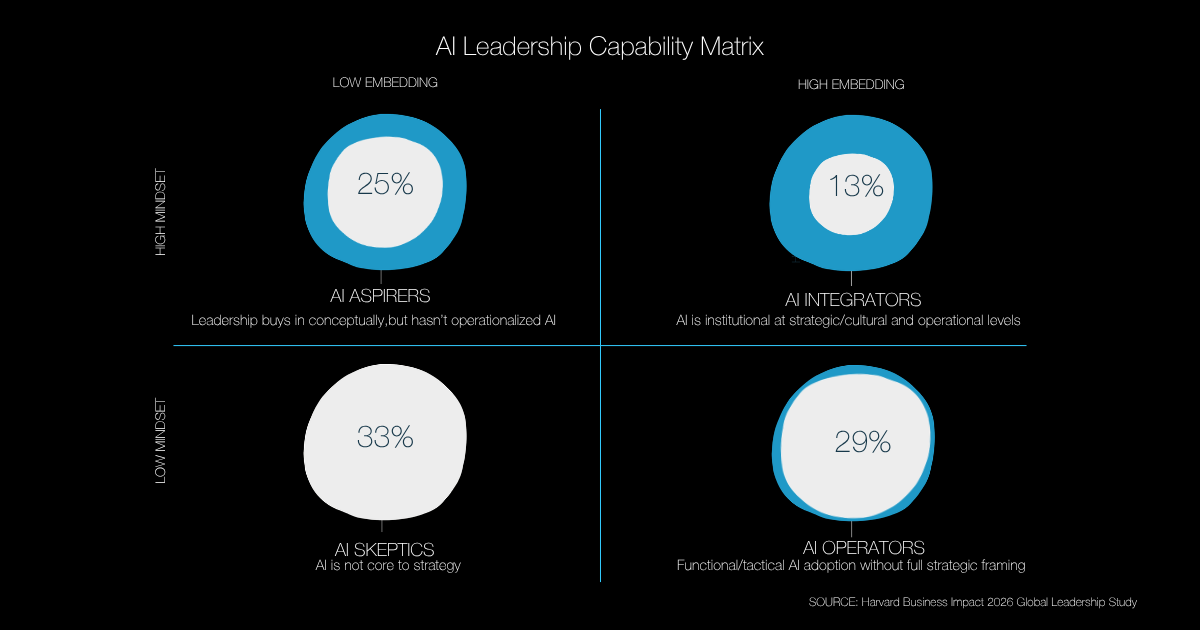
Harvard Business Impact's 2026 Global Leadership Study, surveying more than 1,100 senior leaders across 15 countries, sorts organisations into four groups by how far they've embedded AI and the strategic mindset behind it, and the largest group, 29 percent of organisations, is what the report calls ‘AI Operators’: functionally adopting AI, embedding it into daily workflows, without the strategic framing to go with it.
‘Operators’ look like they're making progress, and the activity is happening, but strategic mindset is what actually turns that activity into value. Another of the reports groups, Integrators, run AI at the same level of embedment, but pair it with a clear strategic mindset, meaning AI isn't just living inside workflows, it's part of how they think about the business.
That difference shows up directly in the impact data. Only 39 percent of Operators report extensive impact on innovation, against 52 percent of Integrators. Only 40 percent report the same for managing and predicting change, against 56 percent of Integrators.
They have the same technology and access but a very different outcome.
What we keep noticing in the leaders who move fastest through this isn't only about how thoroughly AI gets embedded. It's about the kind of thinking the moment calls for. Operators tend to ask how to do the existing work better, faster, cheaper, fewer steps. Integrators ask a different question: what becomes possible now that wasn't before. One is tinkering within a paradigm. The other is reimagining it.
That distinction tracks something adult development research has pointed to for decades: some growth adds skill within an existing frame, and some growth changes the frame itself. The leaders getting the most out of AI aren't asking it to help with the work. They're asking it to help redefine the work.
McKinsey's recent research on AI transformations points at why: leaders reaching for reassurance (your job is safe, this isn't about cost-cutting) often do more harm than good, because the message contradicts the action and breaks trust.
Trust in the organisation, McKinsey found, is one of the strongest predictors of readiness to use AI, and employees who report low trust in their organisation's support are 1.5 times more likely to feel anxious about AI-related change than those who report high trust. Neither training nor reassurance can alleviate that issue.
Employees who report low trust in their organisation's support are 1.5 times more likely to feel anxious about AI-related change than those who report high trust.
Here's where the two reports converge: HBI found the leadership capabilities that rose furthest in importance this year weren't decision-making or AI knowledge, but emotional and social intelligence at 45 percent and agility and resilience at 43 percent, both well above strategic decision-making at 30 percent.
McKinsey's answer is more practical than dispositional. Leaders build trust through a clear plan, even an imperfect one, by getting out into the organisation rather than relying on dashboards. They invest in people's futures rather than just their present roles, and equip managers at every level to have these conversations, not just the executive team.
Different vocabulary, same conclusion: the organisations getting a return on AI aren't the ones with the best models, they're the ones whose leaders can hold the human side of the transformation.
HBI's own framing of this, drawn from the same 1,100+ leaders, is clear:
As AI takes over more of the execution and the analysis, the leadership advantage becomes more human, not less.
The capabilities rising fastest in importance this year, resilience, flexibility, emotional intelligence, sensemaking, and the ability to challenge and contextualise AI-driven outputs, are not the ones any AI system can absorb on a leader's behalf.
The ability to function effectively in an environment of ongoing change, uncertainty, and stress climbed from 30 percent to 40 percent of respondents naming it the most important leadership capability for meeting business needs, in 2026. Not AI fluency or strategic decision-making but the capacity to hold steady, and help others hold steady, while the ground keeps shifting.
Two further human leadership capacities stood out specifically for leading a human-plus-AI workforce: the ability to question and challenge AI decisions, and managing the complex human dynamics that AI activity amplifies, both cited by 44 percent of respondents as top priorities.
Among Integrators, the leaders furthest ahead in embedding AI well, sensemaking under uncertainty was rated extremely important by 54 percent, against 36 percent for everyone else. The leaders closest to AI's real complexity are the ones most convinced the human layer is what makes it work.
Put together, the picture is consistent: judgment under pressure, the discipline to sit with ambiguity rather than resolve it prematurely, and the relational skill to bring a team through a change nobody fully understands yet. None of that is new leadership territory. It's simply become the territory that matters most, at exactly the moment most training budgets are still pointed at the tools.
We ran a session recently with a national financial services company where 60 percent of the workforce had completed one or more technical AI training, and 81 percent believed the organisation already had the learning infrastructure needed to upskill in AI. That training and learning access hadn't moved the needle on customer outcomes or efficiency, and in some areas added more tension with people reporting exhaustion at being asked to "experiment" on top of an already full workload.
Through the diagnosis process, what emerged was that this was a leadership problem, not a technical one, and the infrastructure and the training were already there. What hadn't shifted was how people were thinking about their own work: the question underneath the tool, not the tool itself.
Leaders who went through the session reported a 21 percent increase in their understanding of the distinctly human capabilities the moment requires, and a 25 percent increase in their confidence as stewards of AI adoption, using the technology to strengthen human skills rather than replace them.
Two data points from one engagement, but they sit inside the same pattern both reports describe at scale.
None of this is an argument against training, which builds the foundational literacy that makes everything else possible, but the research this year is consistent: literacy isn’t going to be the differentiator.
The organisations pulling ahead aren't the best-resourced or the earliest adopters. They're the ones whose leaders can hold ambiguity, reimagine and redefine what’s possible, build trust deliberately, and lead people through a shift that can’t be fully mapped in advance. AI has uncovered that capability as an advantage rather than a nice-to-have.
Our perspective on leadership development, from the rooms through to the research. Monthly insight, from our team.
We’ll never spam you and unsubscribe whenever you like.

Quick Links
Acknowledgement of Country
We respectfully acknowledge the first custodians of the land on which we live and work, the Wurrundjeri People of the Kulin Nation. We pay respects to Elders past, present and emerging and to all First Nations People. Sovereignty was never ceded and treaties were never signed.
© Tomorrow Architects Year. Privacy Policy.